Oedipa Maas–Pierce Inverarity relationship
The Crying of Lot 49The Oedipa Maas–Pierce Inverarity relationship is a former affair that persists after Pierce’s death as more than a private memory: his appointment of Oedipa as executor draws her back toward a man whose motives remain uncertain, while the affair becomes part of the pattern through which she encounters the Tristero System. Their intimacy is recalled through comic performance, suspended resentment, and the image of Oedipa as a captive in a tower—an image that complicates any simple account of Pierce as either her rescuer or her escape.
Identity and Background
The relationship began before Oedipa married Wendell (“Mucho”) Maas and had ended a year before the marriage. Mucho knew about it, so Pierce was not a concealed rival suddenly discovered after his death. Yet the past remains emotionally active: when a lawyer’s letter informs Oedipa that Pierce has died and names her executor, the news immediately opens onto memories of their affair and the possibility that its unfinished business has returned in the form of legal responsibility.
The affair is rendered through sharply particular remnants rather than a continuous account of its course. Oedipa remembers a hotel room in Mazatlán, a sunrise over the west-facing library slope at Cornell University, and a dry tune from the fourth movement of Bartók’s Concerto for Orchestra. She also recalls the narrow shelf above Pierce’s bed, where he kept a whitewashed bust of Jay Gould; she had feared it might topple onto them. The recollections move between travel, music, and a domestic object, giving the past the fragmentary, intimate shape of memory rather than a settled history.
The Last Call and Its Afterlife
Oedipa connects the appointment to a long-distance call Pierce made around three one morning the previous year. He began in a heavy Slavic voice, claiming to be the second secretary at the Transylvanian Consulate and asking about an escaped bat; he shifted into comic-Negro and hostile Pachuco dialect, then into the shrieking voice of a Gestapo officer. Finally he spoke in the Lamont Cranston voice he had used on the way down to Mazatlán. Oedipa managed to address him by name and say that she thought they had finished with one another; Mucho, waking and turning toward her, sensibly suggested that she hang up.
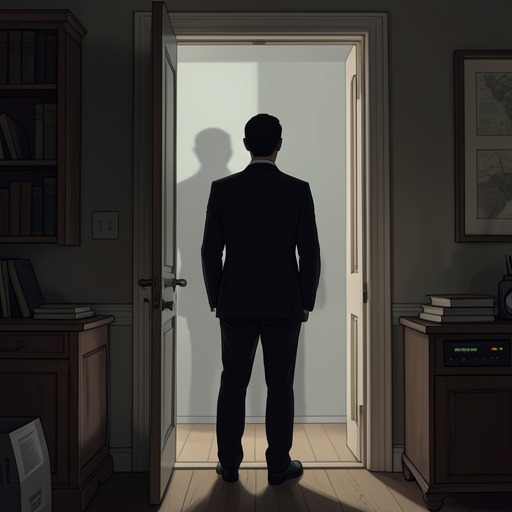
Pierce heard the suggestion and threatened that it was time for Mucho to receive a visit from The Shadow. Silence followed, and the Lamont Cranston voice was the last of Pierce’s voices Oedipa ever heard. The call’s destination and duration remain unknowable to her: the line might have pointed in any direction and been any length. In the months afterward, the ambiguity of that silence gave way to memories of Pierce’s face and body, the things he had given her, and things she had sometimes pretended not to hear him say. He returned to her thoughts and came near to being forgotten; a year after the call, the shadow seemed to arrive in the form of the letter reporting his death.
Death, Inheritance, and Uncertain Motive
The letter came from the Los Angeles law firm Warpe, Wistfull, Kubitschek and McMingus and was signed by Metzger. It said Pierce had died in the spring, although the firm had only just found his will. Metzger was to serve as co-executor and special counsel if litigation became involved. Oedipa had also been named in a codicil dated a year earlier. The timing sends her back to the call: she wonders whether Pierce had called to tell her about the codicil, or whether he decided to include her later, perhaps because of her annoyance during the call and Mucho’s indifference.
The text leaves that motive open. Oedipa feels exposed, outmaneuvered, and put down, but cannot establish whether the appointment was a message, a practical decision, or something else. She has never executed a will and does not know where to begin; when she shows the letter to Mucho, he withdraws with a shy string of blinks and tells her he cannot help, since he cannot even make out their income tax. His response makes clear that the old affair and the new obligation are not shared evenly: he knows the history, but leaves Oedipa to confront the task and its implications.
The Tower and the Limits of Escape
Oedipa later understands her earlier life through the image of a tower. Before Pierce, she had felt insulated from intensity, as though watching a film whose projectionist refused to bring it fully into focus. She had imagined herself as a pensive Rapunzel imprisoned among the pines and salt fogs of Kinneret-Among-The-Pines, waiting for someone to call her down. When Pierce appeared to be that rescuer, she let down her hair; in her retrospective telling, it turned into an unanchored wig, and he fell. The fairy-tale reversal makes the affair’s promise of escape unstable from the outset.
A painting by Remedios Varo gives that instability its defining image. In Mexico City, Oedipa and Pierce encountered a triptych whose central painting shows girls imprisoned in a circular tower, embroidering a tapestry that spills through the windows into a void. The tapestry contains the waves, ships, forests, buildings, and creatures of the earth: the tapestry is the world. Oedipa cries before it, unseen behind dark green bubble shades, and understands that what she had taken to be an escape to Mexico had not taken her away from her confinement. The relationship could open the tower door, but it had not carried her beyond the world made within it.
Place in the Tristero Mystery
After Oedipa’s infidelity with Metzger, she begins to discover what she calls the Tristero System, or simply the Tristero. She later sees that episode as a logical starting point for the chain of revelations, and the logic itself becomes unsettling: the discoveries seem to be in progress all around her. Pierce’s affair with her is not presented as a proven cause of the Tristero mystery. Rather, his death, his will, and the stamp collection he left make the past relationship one of the conditions through which the mystery becomes legible to Oedipa.
The stamps had been one of Pierce’s substitutes for Oedipa: he could spend hours looking into their small colored windows, while ignoring her. Their images opened onto distant landscapes and histories, but she had never understood their fascination and initially saw the prospect of inventorying and appraising the collection as another headache. Only after her seduction by Metzger and other apparently incidental experiences does she become receptive to the possibility that the mute stamps might tell her something. In this way, Pierce’s old attentiveness to the collection outlasts him and enters Oedipa’s inquiry, without resolving whether he deliberately arranged the clues or whether she is finding significance in what he left behind.